Showing posts with label School and Education. Show all posts

Sunday, November 6, 2016

Goulburn Reader Writer Festival this weekend!


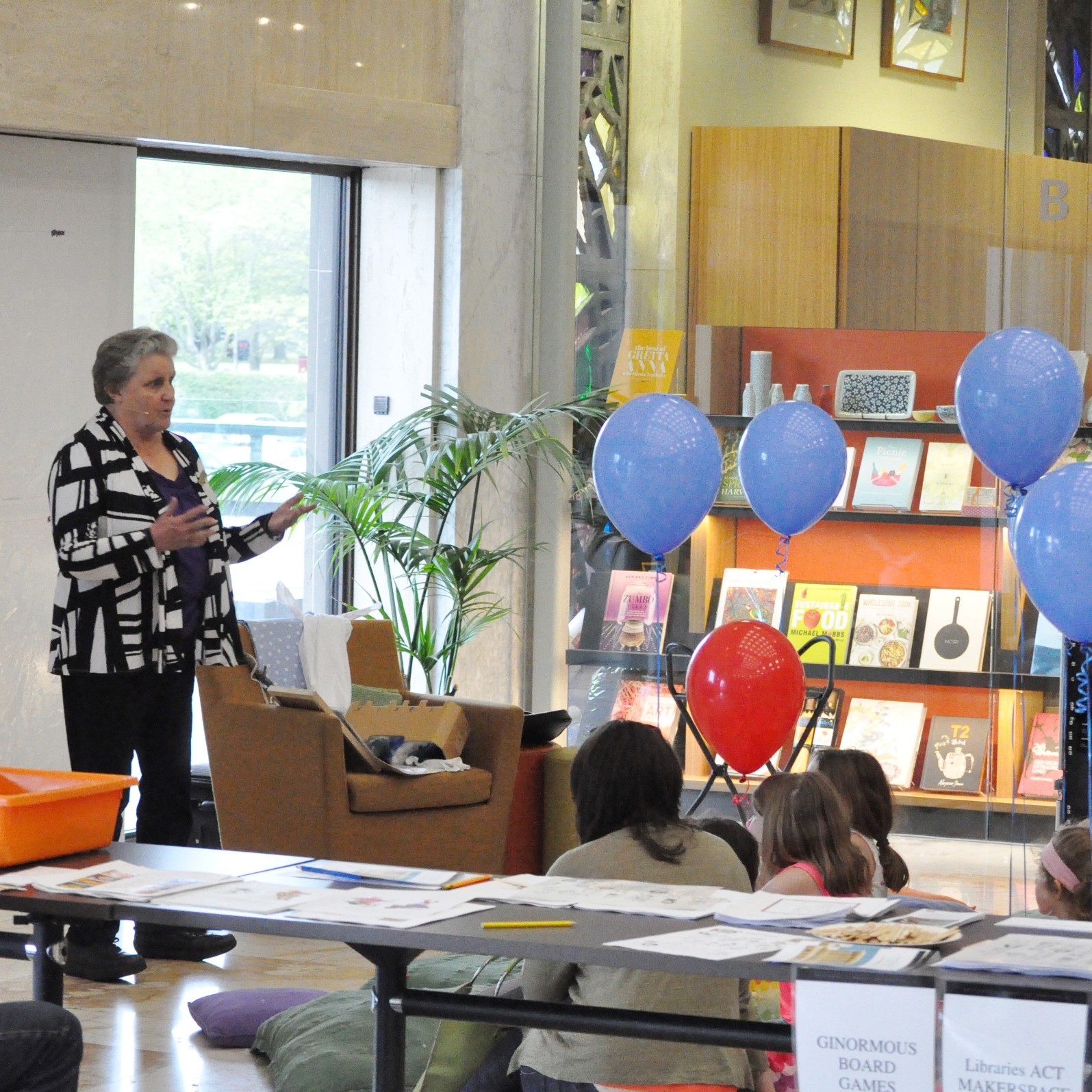
The Goulburn Reader Writer Festival is on this weekend--12 and 13 November--an inaugural event that's absolutely jam-packed with fun for families. 

On Saturday 12, I'll be doing a book reading with other fab authors, Edwina Wyatt and Danielle McDonald, in the Goulburn Library courtyard at 12.30pm--see here for details.

Then I'll be on a panel discussion with George Ivanoff and Danielle McDonald at 1.30pm. We'll be talking about the magic of reading to kids. See more here.

There's also a full day of events on Sunday. It promises to be a fabulous weekend--hope to see you there!

Thursday, August 25, 2016

Book Week 2016 Highlights


I've just hung up my book bag after a full and sensational Book Week here in Canberra. It's such an enriching, fulfilling week of talks, presentations, book readings and conversations with the very people we create books for (and their highly supportive teachers and librarians!).

Each year, it never fails to astound me how dedicated schools are to one of our most fundamental human needs--literacy. And with literacy, of course, comes creativity, understanding, empathy, intelligence (both emotional and mental) and ... very best of all ... pure enjoyment. See my posts Encouraging Children to Read for Pleasure Part I and Part II.

This year, the majority of my sessions were an interactive presentation called I Love Books. The kids learned about the vast and varied types (learning word: genres) of kids' books, target markets and all about book creators, and who is actually involved in the book creation process (including them!). They also learned about drafts and editing and illustrator roughs (another learning word).

The presentation is designed to get the children talking, giggling, sharing and laughing--and we had so much fun, my mouth is actually hurting from smiling!


Of course, costumes and book parades were in full swing all over Canberra, and it's one of my favourite parts of Book Week because it gets the kids so completely involved and enthused. Yes, there were plenty of Cats in their Hats, and Lost Wallies, superheroes and princesses, but each year, things get more and more imaginative and I so enjoyed meeting all manner of interesting characters, including a tornado! Perhaps from the Wizard of Oz?

Who doesn't love a good dress-up!?

I also love how much school staff get into the swing of things. One school even featured a line-up of Mr and Ms Men characters for their staff.

Another school had an Australia! Story Country theme (the CBCA's theme for Book Week 2016) and it was absolutely brilliant. Without being able to rely on costumebox.com, the resulting creations were the stuff of imagination--there was everything from Green Sheep and Alexander Bunyips through to Andy and Jill from the Treehouse series, below.

Some of my absolute favourites were the proliferation of gumnut babies--the costumes were the most darling things ever. I so wish I could show you photographs. And probably my favouritist of all, was the Book Fairy (at the top of this post) whose mum created these divine wings folded from the pages of a book, complete with book cover and Scrabble letter spine.

Genius!

permission granted for this pic of Jill and Andy

On the Wednesday evening, the CBCA ACT Branch hosted the annual Children's Seminar (big thanks to Turner School for hosting--Jo and Norma!) where local authors chatted in rounds with groups of school kids, followed by a delicious afternoon tea and Happy Birthday cake for 70 years of the Children's Book Council of Australia.

CBCA Children's Seminar
L-R: Stephanie Owen Reeder, Tania McCartney, Pauline Deeves, Harry Laing,
Craig Cormick, Jordan Morris

We then held a panel and laughed our way through a series of Q&A. Too much fun.

This was followed by dinner at a local restaurant where I got to hold Stephanie Owen Reeder's CBCA winning medal (it's gold! it's heavy! it's beautiful!) for the Eve Pownall Award (for Lennie the Legend). We're so proud of our local gal.

Thank you to the CBCA for keeping Book Week so strong in our communities, and thanks to the book-loving librarians, teachers, executives and kids for the most wonderful week. I am tired but all-full-up with happy. And thank you to all the parents out there who so enthusiastically make books and reading a big part of their kids' lives. Believe me, every time I spend time with these fresh, bright, intelligent, creative school kids, your commitment shows.


Saturday, August 20, 2016

Seeing Stories Finale Event wrap-up


Today I had the great pleasure of attending the Seeing Stories Exhibition Finale Event at the University of Canberra. Organised by the National Centre for Australian Children's Literature (NCACL) and featuring hand-picked originals by some of our finest illustration talent, including Terry Denton, Ann James, Alison Lester and Bob Graham, The Hub was alive with stunning artworks, authors, illustrators, kids and book lovers.

This exhibit is but a small slice of the precious John Barrow collection, now owned by the NCACL.

Bob Graham


Leigh Hobbs

Local creators Emma Allen, Pauline Deeves, Kerry Malone and myself were joined by illustrator Hannah Sommerville (who illustrates Emma's books) for an afternoon of readings and chats and fun. I read Smile Cry and Tottie and Dot, followed by my very first live-drawing session. The kids had to guess what I was drawing, and of course, guessed after 8 or 10 lines--these kids are too clever--or maybe I have to up my game!

Emma and Hannah spoke about their collaboration as author and illustrator, bringing along an impressive dress-ups box, a thread in their beautiful book My Friend Ernest. Pauline Deeves also launched her book Socks, Sandbags and Leeches--an astonishingly detailed historical account of the homefront for kids during the Great War. Kerry Malone spoke on creating stories for kids. Unfortunately, I had to leave early, so don't have photos of these other events.

A face painter charmed the kids with her artwork (see a version of Old Tom, below!) and a table of art supplies was a big hit, while adults (and kids) perused the art. Harry Hartog Booksellers were in attendance (thanks, James!) so creators could sign books.

Alison Lester

Elizabeth Honey


Leigh Hobbs

organisers and creators mingle, including, from right, Kerry Malone, Emma Allen, Belle Alderman, Hannah Sommerville

the face painter did a brilliant job!

Emeritus Professor Belle Alderman and illustrator Hannah Sommerville

face painter at work


a little book reading, complete with Dot glasses

my first ever live drawing - eep!

May Gibbs quilt

Featured at the event was a divine quilt featuring the artwork of May Gibbs (in celebration of 100 years since the publication of her first book).

Raffle tickets for the quilt are available for purchase from anywhere in Australia, and you can find out more about this right here, or you can email Trish Milne at ncaclraffleATgmail.com to organise tickets, just $2 each or 3 for $5. (I'll do a separate post on the quilt on KBR soon.)

The raffle will be drawn at the National Botanic Gardens on Sunday 23 October, and all proceeds go towards supporting NCACL.

kids are so brilliant

A huge thanks to Belle, Rowan and the crew for a magnificent exhibition and celebratory event. This beautifully-crafted, heart-racing display is on show till Friday 26 August, so if you're in Canberra this week, do hurry along before you miss your chance to see something really special. More info can be found here.


Sunday, May 15, 2016

Chief Minister's Reading Challenge - school visit


One of the great joys of being a children's author, is chatting with kids about story--and hopefully, just hopefully, having them fall in love with books.

In my role as an ambassador for the Chief Minister's Reading Challenge for 2016, I get to have that chance even more than I regularly do. I also get to visit brand new schools, like Charles Weston school in the far west of Canberra--a brand new, state-of-the-art school, with fabulous kids eager to learn and grow.

I talked to them about books--about writing books, illustrating books, reading books, loving books. I talked about how much fun books can be, and how important story is. The kids were so receptive and so curious. They giggled and commented and asked questions and threw themselves straight into the pages of the books I'd brought along, the very moment they could. Now--that's what we want.


One of my favourite moments was showing them a 3D story called Jim Curious. These three little poppets (below) donned their 3D glasses, only to be met with a rather ferocious shark! They loved it--and they were so brave! (Note the little one biting her nail!)


This is what we want for kids--reactions to books. We want to take them to other places. To send them on adventures. To make them feel and think. When we do this, we not only educate, enchant and entertain, we do the very best thing we can to encourage literacy.


My other favourite part was chatting to the kids one-on-one after the presentation. Below, I'm chatting with a girl with Scottish heritage, taking her through A Scottish Year. Note the little loves, bottom right, with that fabulous 3D book!


Thank you to Lauren and Dave from the Chief Minister's office for organising this fabulous visit, and to Mr Spencer and the kids from Charles Weston for having me. Books rock!

Friday, April 29, 2016

Exploring Time and Place Through Children's Literature

from Australian Kids Through the Years, image by Andrew Joyner

Not sure if you know (!), but I love books. And reading. And other cultures. And watching children grow and learn and thrive with the inclusion of all three of these vital components in their lives.

A few months ago, I was asked to write an article for Connections magazine, an initiative of the Schools Catalogue Information Service, which serves schools and libraries in both Australia and New Zealand. The article has just been published in the magazine, and is also online.

In it, I discuss the importance of exposing children to books featuring other places, times, races and cultures. I talk about the benefits of multicultural exposure, which include broader minds and a deeper understanding of both the self and others. Children exposed to other ways of life have a greater willingness to explore and experience life to its fullest, and to pursue friendship, relationship and career opportunities unbound by prejudice, stereotypes and limited thinking.

Now do you know why I love books, reading and other cultures?

You can read the entire article right here.

Sunday, February 21, 2016

Chief Minister's Reading Challenge

http://www.det.act.gov.au/teaching_and_learning/chief_ministers_reading_challenge

From Monday 22 February to Friday 9 September 2016, the Chief Minister's Reading Challenge for the ACT, will be in full swing. Kids all over the territory are invited to participate in this wonderful initiative--and all they need to do is read 15 books in that time (or many, many more, of course!).

Schools can register for the Challenge online and each student keeps an individual reading record. Books can include anything that interests them, from poetry to novels and non-fiction.

I'm so excited to be a CMRC ambassador for 2016, along with other local book aficionados, Irma Gold, Jack Heath, Tracey Hawkins and Virginia Haussegger.

Learn more about how to participate here, and meet the 2016 Ambassadors here. We will be visiting schools around town these coming six months... I hope to see you at your school!


Sunday, November 29, 2015

Australian Kids Through the Years on the cover of Scholastic's Teacher's Bookshelf


Such a lovely moment to have my son bring home the latest Scholastic Teacher's Bookshelf from school, and see Australian Kids Through the Years on the cover!


Saturday, October 10, 2015

Book Launch for Australian Kids Through the Years


We had the loveliest launch for Australian Kids Through the Years at the National Library today, during their Imaginarium Family Day.


What an amazing afternoon--seeing kids descend en masse for all manner of cool happenings, from mini helicopter flying to an enormous chessboard, 3D printing, paper plane fyling, musical instruments made from fruit, the Scrabble Championship and of course--authors!


Stephanie Owen Reeder (above) had littlies grooving along to her Dance Like a Pirate book, followed by Pauline Deeves (below) and her glimpse into the past--how life was lived a hundred years ago and how dolls were often made from hankies (her hanky was clean)!


Next was my launch for Australian Kids Through the Years--and the children were clearly story-lovers. They were just so engaged and so clever. Who'd have thought that a 6-year-old would know that a fiddle was a violin!?


After a book signing, David Astle had kids mucking around with words in a wonderful way, then Stephanie did a presentation on her book Lost! (alas, I couldn't stay for that one).


Congratulations to the National Library for a superb afternoon!

Thursday, August 27, 2015

Encouraging Children to Read for Pleasure, Part 2


This is the second in my Reading for Pleasure articles. To see Part 1, click here.

Genre

One of the greatest things we can do to encourage kids to read for pleasure is to find ways for them to connect with works they can relate to and enjoy. The bulk and variety of books available on the market is astounding, and our local book industry boasts a formidable amount of quality books. This can overwhelm adults, let alone children, let alone reluctant readers.

My suggestion is to look at genre.

For teachers and librarians, creating some kind of book genre feature or event would be a great way to sift through the literary mire. Book-lovers will be there, on your doorstep but focusing on one genre more intently will bring in the stragglers�if they happen to resonate with that particular genre. So perhaps July is picture book month. August is illustrated junior fiction. September is young adult fiction with a romance focus or a focus on death.

We already know that once a child engages with a particular book, they eagerly lap up any further titles in the series. This sends a clear message that once children engage with a certain style, character, genre or even author, they�ll continue to seek out and read books of this nature. You can find books in varying genre on Kids� Book Review.

Even when we identify genre, we will need to connect kids to books BEFORE we connect them to reading. We need to make books cool. Indispensable. Worth the time invested, and the literacy effort. We can�t insist. We can�t make it a chore. We can�t expect them to engage in a struggle, whether by content or competency. Kids don�t care about the priceless end-value of full adult literacy. They only know here and now. And here and now is all about them. About enjoyment and pleasure.

Deterrents 

So, we know how to encourage kids to read for pleasure, but what are the pleasure deterrents to avoid?

Literacy problems are a major deterrent and of course need to be dealt with by using applied teaching methods. But we can still foster a love of books and story without confuddling that love with decoding or audio comprehension issues. We can do this for all ages with a focus on visual literacy, whether it be picture books, wordless picture books, comics, non-fiction texts, illustrated fiction or graphic novels.

Visual literacy. See this post for a comprehensive outline.

There�s a perception among some kids that reading is not cool, which is why we need funny books and books that push boundaries. We can�t underestimate the power of humour and sheer silliness, especially for younger or less mature children. We need silly. We need outrageous. We need dry, even dark, concepts. Cautionary Tales are a great example of this kind of humour.

At the children's Book Council of Australia conference in 2014, Andy Griffiths spoke of the dichotomy between adults� and children's reactions to his books. In The Bad Book, there�s a story called Bad Mummy and the Very Busy Six-Lane Highway in which a young lad begs his rather vacant mum to run across six lanes of traffic. At first, she�s not so sure, but the kid whines, so mum says yes. Off the kid runs, and WHAMMO! He�s smashed to bits by oncoming traffic.

Of course, children laugh their heads off at this story. Andy told us he's discussed this story with many a five-year-old and when asked if they thought it might encourage THEM to run out on a six-lane freeway, the kids laughed harder and said �it�s just a story! that kid was silly!�.

Children understand the concept of dry humour more deeply than we could ever assume. We need to trust them.

Too PC, didactic or moral. We can�t hammer kids over the head with morals. We just can�t. They�re too smart, and they�ll just intellectually and emotionally rebel. In fact, I would say that books with heavy morals (other than cautionary tales, of course) can be the ruination of book love for children. MOST books have some kind of messaging inherently woven into story but it must be almost imperceptible or at least humorous. Don't worry--kids WILL get it!

In the 1920s, our own May Gibbs released her series of totally UN-PC gumnut babies into the world, with full-frontal nudity and plenty of bare bums. No one batted an eyelid, yet nothing like this would ever pass publication today. May had a wicked sense of humour and some of her text certainly pushes modern day political correctness. In Boronia Babies, an innocuous booklet for children, first released in 1922, we meet the Rose Babies. Herewith the text:

These are native Rose Babies. They are second cousins to the Pale Pink Boronias, and considered rather eccentric by their friends. See the little mothers hurrying to get their babies. If they are not quick, the buds will open right out and the babies will fall down� and DIE. 

Won�t see that kind of text in modern day books, no no.

We should also be wary of mollycoddling and sheltering kids. Life is not sunshine and rainbows and excessive political correctness doesn�t wash it with kids. �Controversial� books like Coles Funny Picture Books are a case in point. Much of the content of these books was exciting and naughty and funny and horrifying and pushing social boundaries yet kids should be entrusted with receiving and processing tales and concepts that will expand their understanding of the world and how others think. It's also important for kids to learn, just like the kid and the 6-lane highway, how NOT to be. What NOT to do.

Another deterrent is the perception that other things are more fun than reading. Kids have such limited time. They are so jammed with Too Much, both during and after school, and on weekends--they simply don�t have the opportunity to fill long, languid hours curled up with a book. A return to more simple, slower, easier living�for both adults and kids�is most certainly something that will soon be a necessity for humankind, not a luxury.

Not enough variety. There is a movement in the US that you may have heard of--#weneeddiversebooks. As our world population expands and children are born into increasingly unique circumstances, in richer and poorer environments, in blended families and cultures and race, we need to provide a larger diversity in subject matter and characters that our increasingly diverse kids can relate to. All children need to relate to stories. They need stories in their mother tongue. Our First Children need books with their own stories, their own Aboriginal culture. They need stories and characters who share their way of life. This is prime way to engage any kind of kid with books.

Dumbing down the dialogue. When Hachette UK made the confounding decision to �modernise� Enid Blyton�s works, I wasn't the only book lover mortally wounded. Fanny and Dick became Frannie and Rick for reasons you might well guess. Bessie was replaced by Beth because Bess is believed to be a stereotypical name for black women and therefore carries racist overtones. Dame Slap became Dame Snap because the word slap might prove too traumatic for little ones, or indeed, might encourage children to walk around slapping each other. Jo was change to Joe, presumably because the publishers didn�t want young readers to believe Jo may be a transvestite. And the biggest travesty of all? The term Swot was changed to Bookworm. Not only are these two words UNinterchangeable, there is little more evocative and rich with meaning than the word �swot�. To rob modern children of this word is untenable. Don�t even get me started on Noddy.

To engage children deeply with books, don't hesitate to offer them more advanced and sophisticated books in regard to text and vocabulary or content. They will either get it or they won�t, but they�ll learn so much along the way, even if they're not consciously aware of it. Children NEED to be exposed to words like �swot� and �fandangled�. This is priceless for vocabulary expansion, as even the very young quickly learn words by context and association. Plus, they sound so utterly delicious.

Picture books shouldn't be underestimated when it comes to reluctant readers (or any reader!). Learn more about this in my The Power of the Picture Book post.

Reading is more than about great story. When a child reads, they achieve language and comprehension skills. They become more literate, expand their vocabulary, develop comprehension and learn to use complex grammatical construct. They also develop writing and spelling skills.

But most of all, when children read, they have the opportunity to fall in love with story. To travel. To float above the real world and enter new places, achieve new experiences, expand their minds, hearts and souls. They may even find comfort there. And always, always, pleasure.

See Part 1, where I discuss the importance of entertainment in developing book love, and how to develop a reading culture in the home and at school

These posts are excerpts from my professional development talk given to teachers and librarians at Marist College Canberra, June 2015.

Be sure to check out KBR for some sensational book suggestions!


http://www.kids-bookreview.com/

Monday, August 24, 2015

Encouraging Children to Read for Pleasure, Part 1


Books are extraordinary objects. They may be comprised of ink and paper, but once opened wide, some kind of magic happens, and entire worlds tumble out. Books enchant, enlighten and educate. They befriend and support. They can take you on a journey. They have the capacity to lift, move and surprise. They can provide buoyancy, and sometimes, they can even rescue.

Reading brings colour, vigour, entertainment and satisfaction. It builds self-confidence, competence and intelligence. It fosters hope delight and creativity. It hones aptitude, imagination and independence. Engagement with storytelling links directly to emotional development, greater social skills, wider horizons and broader general knowledge. It can make kids more articulate, develops higher order reasoning, and promotes critical thinking. It brings with it an internal sense of freedom that only fluent readers can ever know.

Alas, there are so many who do not know that freedom. As an ambassador for the National Year of Reading (2012), our central message was to create a book culture in the home�to start with the child when they�re very young. To create a love of reading for PLEASURE. If parents read to their kids from the start, children begin to associate reading with being loved. If children can fall in love with books and reading via the avenue of pleasure and being loved, we have a far greater possibility of fostering life-long readers.

We want kids to see reading as a joy, not a chore.

As a book creator and founder of Kids� Book Review, my goal is to write books that entertain first, educate second. Entertaining books draw children into reading by falling in love with books and story. The books that really draw children in are those that allow the reader to create their own world, their own experience, within the confines of story, and of course, allow the reader to somehow relate to the characters�whether it be by affiliation or desire.

Reading for pleasure is the most difficult for children struggling to read or who are reluctant readers. As schools persist with programmes to better the literacy skills of these children, developing a complementary reading culture in the home and focusing on the pleasure of books in general is vital.

So, how do we foster a fondness for books that precedes learning to read or even comprehension?

We start from the beginning, of course.

The most active period of brain growth for humans is between the ages of birth to three, with most brain patterns set for life by the age of seven. While sharing books with children as young as newborn is vital for brain development, and gives kids a phenomenal life advantage, reading to children inutero is also believed to give kids a strong foothold for reading, helping them develop an early appreciation of the cadence and intonation of their mother tongue language, which gives them not only a language foothold but develops an eventual love of story.

Similarly, reading to very young babies opens a sensory wonderland of language, relationship bonding, visual and emotional stimulation, and the cause and effect of page turning, suspense, expectation.

As children grow, developing a reading culture in the home is one of the greatest ways to indirectly (but powerfully) support and supplement the work of teachers and librarians. For children whose home environment supports a reading culture, encouraging them to read for pleasure is a breeze. For those without, these benefits, things become more challenging.

Ways for teachers and librarians (and parents!) to encourage this home-based reading culture include:

  • borrowing books from the school library to take home; this encourages variety but in some cases, it also bring books into a home with scant or even no books
  • appointing a child to take home the library mascot for the weekend
  • setting homework challenges that involve books in innovative ways, for example, building something from a particular book from recycled materials or Lego and bringing it to school or creating pictures from a story, or going as a family to visit certain sites around town that could some way relate to a book, perhaps the beach or town hall
  • adding library and book news to school newsletters
  • running book-related competitions in school newsletters
  • using movie or internet tie-ins to highlight books for parents and children; this is a wonderful way to make the book look cool and some kids may not know this film was once a book
  • having visiting authors for children; they will talk about the experience to parents, which heightens book excitement and engagement
  • having literacy expert visits to talk to parents in the evening
  • sending home reading challenges or being part of your state or territory premier�s reading challenge
  • donating ex-school-library books to children who have few books at home
  • fostering the ideology of reading for naught but pure pleasure; making reading fun, making it exciting and cool

It�s interesting to note that homes that do provide a reading environment for children can still form reluctant readers. Studies show that children brought up in a home that viewed reading as a source of entertainment had greater reading-related skills and competencies than children raised in homes that placed greater emphasis on the skills-related aspects of reading and literacy.

Essentially, parents who believe in reading for pleasure tend to provide more opportunities in the home for children to fall in love with books, and therefore more readily acquire the desire to persist with reading, even if they struggle with the skills required.

To encourage a reading culture at school:
  • Provide a broad selection of books and hold as many copies as humanly possible of popular books. If their are budget or staff or space constraints, perhaps have a book drive for second-hand books and get kids involved in cataloguing and shelving.
  • Try to control book snobbery and teeth-grinding stereotype aversions if you possibly can. I know. It's sometimes hard! But a book is a book is a book and it�s important that kids read what attracts them.
  • Allow children to choose their own books. It doesn�t matter what kids read so long as they're reading. Much better to study or read a text that at least resonates with each child independently, than study a book that blocks any kind of learning and absorption through displeasure or even angst.
  • Harness the power of humour�never underestimate its ability to draw kids in.
  • Also harness the power of pop culture. What are favourite sports or movie stars or pop stars reading? Which book-to-movie release is particularly huge right now? Take advantage of the hype and be sure to tell kids the book is always better than the movie.
  • Have kids organise events or initiatives themselves�put them in control. What about a student-led book swap?
  • Give students responsibility�especially troubled kids who can develop self-esteem from tutoring or supporting younger children.
  • Have authors, sportspeople or well-known people visit your school and get involved in some way.
  • Think outside the square in terms of reading material. Have children locate and bring to school other reading items such as event programmes, a menu from a really cool restaurant they've been to, or even footy fixtures. They won�t even know they�re reading.
  • Also look to magazines, websites and picture books for older kids and even high school students, for enhanced visual literacy. Visual literacy helps children take pleasure in image as well as words. Use maps, diagrams, paintings. Have children look for story in paintings. Wordless picture books are also an extremely powerful storytelling medium that can enhance reading skills and foster an intrinsic love of books because they�re non-threatening textwise.
  • Have children utilise the technology they love so much to create book trailers or mini movies based on books or stories.
  • Consider oral storytelling and plays to encourage a love of story. 
  • Use books for more than just reading. Create exciting displays or have kids create their own. Use books for artistic or craft projects. While I don�t condone the desecration of books, you could use old or dilapidated books for exciting projects, or create something where the book stays intact. Make the physical form of a book exciting and creative for children and they will more likely associate this form with pleasure, excitement, emotional satisfaction.
  • E-books engage children because they�re platform-based and platforms are something kids know well. If they�re interactive, they�re a great way to engage and stimulate kids in a multi-sensory way, however, they can�t, of course, replace real books and being able to immerse into a story without distraction/constant interaction.
  • Rewards are up to you. The concern is that rewarding children for engaging in an activity that they may just enjoy anyway, could lead them to participate for an extrinsic reason rather than in intrinsic one. Intrinsic reasons are important because reading is reliant on self-efficacy or the belief in one�s own capabilities. This belief influences the choices kids make and the actions they pursue, including reading. So we really want kids to read for intrinsic purposes.
  • Frequent creator sites to learn more about authors and illustrators, their processes, behind the scene peeks. This kind of interaction with real life creators is a priceless way to have kids engage with books. Most children just see the book. They don�t see what�s BEHIND a book, and this is always fascinating. See my Riley the Little Aviator site for an example of interactive content for both adults and kids.

See Part 2, where I discuss the effectiveness of genre, reading deterrents, and the importance of humour. For visual literacy, see this post for a comprehensive outline, and learn more about the importance of picture books for older readers in my The Power of the Picture Book post.

These posts are excerpts from my professional development talk given to teachers and librarians at Marist College Canberra, June 2015.

Be sure to check out KBR for some sensational book suggestions!


http://www.kids-bookreview.com/